
Pimpama went from a cane-farming village to one of the fastest-growing suburbs in Australia inside a single decade. The 2011 census counted 3,211 residents here. By 2021 it was 24,601, and the estates have kept spreading north toward the Pimpama River ever since.
The suburb has a median age of 29 — eleven years below the national figure. Most households are young families with a mortgage, two cars, ducted air conditioning and a daily routine that leaves the house empty between 8am and 5pm.
That combination is exactly why solar panels in Pimpama perform better than almost anywhere else in the country. This guide covers what actually works on a 4209 roof in 2026: system sizing, the current rebates, Energex export limits, realistic costs, and the installation traps that catch homeowners in new estates.
Why Pimpama roofs are built for solar
Three things line up in Pimpama that rarely line up together.
1. The sunlight
Pimpama receives roughly 5.17 kilowatt-hours of solar irradiation per square metre per day. Queensland averages about 5.2 peak sun hours — the best of any Australian state — and the northern Gold Coast sits right on that number. A panel installed here generates meaningfully more over its life than the same panel in Sydney or Melbourne.
2. The roof stock
A large share of Pimpama’s housing was built in the last fifteen years on converted farmland. That gives you wide, low-pitch roof spans with good north-facing orientation, modern trusses rated for panel loads, and — critically — no mature trees casting afternoon shade. In older suburbs, shading is the single biggest reason a system underperforms its modelling. Here, it is usually a non-issue.
3. The switchboard
Newer estates generally have modern switchboards with spare capacity for a solar circuit and, later, a battery circuit. That avoids the several-hundred-dollar board upgrades that older suburbs frequently need. If your property is in the original Pimpama township rather than a newer estate, we check this at assessment before quoting.
Solar uptake across postcode 4209 already sits among the highest in Australia. That is good news for the environment and slightly awkward news for your export limit — see the Energex section below.
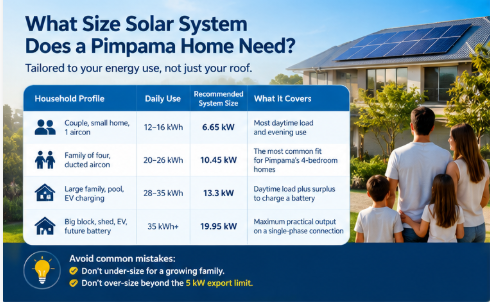
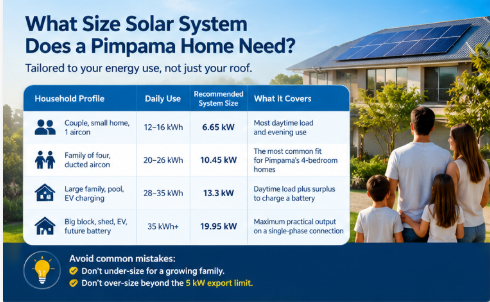
What size solar system does a Pimpama home need?
There is no single right answer, because sizing should follow your consumption, not your roof. As a rule of thumb, a Queensland household needs roughly 1.5 kW of solar for every 6 kWh of daily electricity use to meaningfully offset its bill.
| Household profile | Typical daily use | Recommended system | What it covers |
|---|---|---|---|
| Couple, small home, 1 aircon | 12–16 kWh | 6.65 kW | Most daytime load and a solid chunk of evening use |
| Family of four, ducted aircon | 20–26 kWh | 10.45 kW | The most common fit for Pimpama’s 4-bedroom homes |
| Large family, pool, EV charging | 28–35 kWh | 13.3 kW | Daytime load plus surplus to charge a battery |
| Big block, shed, EV, future battery | 35 kWh+ | 19.95 kW | Maximum practical output on a single-phase connection |
Two sizing mistakes are common in Pimpama specifically.
Under-sizing for a growing family. The suburb’s median age is 29 and its median household already has children. A system sized for a couple in 2026 will be too small by 2031. Panels last 25 to 30 years, so plan for the household you will have, not the one you have now.
Over-sizing on a 5 kW export cap. Pimpama homes are mostly single-phase with a standard export limit of 5 kW. If you install more generation than you can either use or export, the inverter throttles the surplus and you have paid for panels that produce nothing. Anything above about 6.65 kW should be designed as a battery-ready system rather than a pure export play.
Solar rebates available in Pimpama in 2026
Queensland homeowners currently have access to federal support only — there is no state battery rebate. Here is exactly what applies today.
Federal STC discount on solar panels
Small-scale Technology Certificates are applied as an upfront discount on your quote — you do not apply for anything or wait for a cheque. Your installer creates and assigns the certificates and deducts the value from the price. A typical 6.65 kW system in South East Queensland attracts roughly $1,500 to $1,700 off in 2026.
One date matters here: the deeming period steps down each 1 January, which reduces the discount by roughly 7 to 8%. A system installed in December 2026 costs materially less than the identical system installed in January 2027.
Cheaper Home Batteries Program (federal)
If you are adding battery storage, this is where the real money is — around 30% off the installed cost. But the rules tightened on 1 May 2026, and a lot of quote templates in circulation still use the old numbers.
| Usable battery capacity | Share of the STC factor |
|---|---|
| First 14 kWh | 100% |
| Above 14 kWh up to 28 kWh | 60% |
| Above 28 kWh up to 50 kWh | 15% |
| Above 50 kWh | No support |
The current factor is 6.8 certificates per usable kilowatt-hour, which works out to roughly $260 per usable kWh at recent certificate prices. A 13.5 kWh battery therefore lands around $3,500 in upfront discount; a 10 kWh battery around $2,600.
That factor drops to 5.7 on 1 January 2027 — a 16% cut applied to the same hardware. On a 13.5 kWh battery that is roughly $570 of value evaporating on a fixed date, which is why early-2026 enquiries in Pimpama have been running ahead of last year.
✓
Watch out for this: Queensland’s Battery Booster program closed in May 2024 and nothing state-level replaced it. Any Pimpama quote advertising a “QLD government battery rebate” on top of the federal discount is either out of date or double-counting. The federal discount is generous on its own — you do not need a fictional one to make the numbers work.
Supercharged Solar for Renters (worth knowing)
Pimpama has a high rental share — around 57.6% of households at the last census. The Queensland Government’s Supercharged Solar for Renters scheme pays up to $3,500 to the landlord to install solar on a tenanted home. It has been open since December 2025 and the property must be individually metered, rented for $1,000 a week or less, and owned by an individual. Critically, conditional approval must be granted before installation begins — install first and you forfeit the payment. If you own a rental in Pimpama, this is worth a conversation.
Is a battery worth it in Pimpama right now?
For most Pimpama households, yes — and the reason is not the rebate. It is the feed-in tariff.
Feed-in tariffs across South East Queensland have fallen sharply. Ergon’s regulated rate in regional Queensland dropped from 8.660c to 6.006c per kWh on 1 July 2026, a 31% cut in a single year. South East Queensland, including Pimpama, has no mandated rate at all — retailers set their own, and the gap between the best and worst offer is wide enough to be worth shopping around on Energy Made Easy.
Meanwhile you are buying grid power at roughly 27 to 28 cents per kWh.
Exporting a kilowatt-hour earns you around 6c. Using that same kilowatt-hour in your own home saves you around 27c. The round trip is worth roughly four and a half times more than the export.
On top of that, a single-phase Pimpama home with a 5 kW export limit cannot send everything a 10 kW system produces onto the grid at midday. A battery absorbs that otherwise-curtailed surplus and releases it into the evening peak — the exact hours when a family of four with ducted air conditioning is actually drawing power.
A well-matched 10 to 14 kWh battery sits entirely inside the full-rate rebate band, which is also the size that matches a typical evening household load. Going much larger buys you a lower rebate per kilowatt-hour and a longer payback. Sizing the battery correctly matters more than sizing it generously.
Energex connection and export limits in Pimpama
Pimpama is on the Energex network, and no solar system can be switched on until Energex approves the connection. Your installer lodges the application — you do not need to deal with it — but you should understand the limits, because they shape what we can design.
| Connection type | Maximum inverter capacity | Maximum export |
|---|---|---|
| Single phase — fixed | 10 kW total (solar + battery) | 5 kW |
| Single phase — dynamic | 10 kW solar + 10 kW battery | Up to 10 kW variable |
| Three phase — fixed | 30 kW total (10 kW per phase) | 5 kW per phase (15 kW total) |
| Three phase — dynamic | 30 kW total (10 kW per phase) | Up to 10 kW per phase |
Dynamic connections are usually the better choice. On a single-phase property they allow separate allocations for solar and battery, which means you can run a larger battery without eating into your solar inverter allowance — and you can export far more of your midday generation on the days you are not home to use it.
The process runs in a fixed order: connection application lodged and accepted, then installation, then an Electrical Work Request submitted by the installer, then your meter reconfigured for export. If you do not already have a smart meter, your retailer will arrange the swap — the system stays switched off until that happens. Expect the whole sequence to take a few weeks on a straightforward residential job.
One exception worth checking: if your property is on the legacy 44c Solar Bonus Scheme, do not add panels or a battery before 1 July 2028. Any modification ends the scheme early, and the 44c rate is worth far more than the savings from an upgrade.
What solar costs in Pimpama
Installed prices across South East Queensland vary with system size, panel and inverter brand, roof complexity and whether you add storage. As a realistic guide for 2026, after the federal discount has been applied:
- 6.65 kW system — the entry point that suits a couple or small family
- 10.45 kW system — the mainstream choice for Pimpama’s 4-bedroom homes
- 13.3 kW battery-ready system — for larger loads and future storage
- Battery add-on — roughly 30% off the installed cost through the federal program, tapering above 14 kWh
We do not publish a single headline number, because a Pimpama quote that fits a 3-bedroom home near Pimpama Junction will not fit a 5-bedroom property with a pool in one of the newer precincts. An itemised quote based on your actual roof, switchboard and consumption is the only useful one.
Be sceptical of any Pimpama quote that is dramatically cheaper than the rest of the market. The Gold Coast and Brisbane installer market is one of the most competitive in Australia, and the cheapest quotes are usually cheap for a reason — subcontracted crews, unbranded inverters, and a warranty that expires when the company does.
Choosing a solar installer for a Pimpama installation
New housing estates create a specific installation risk. Roofs go up in volume, and the trades move fast. What matters for solar is less about the suburb and more about who is on your roof.
- Clean Energy Council accredited installer. Non-negotiable, and required to access the federal rebate at all.
- In-house installation team. Ask directly whether the crew is employed or subcontracted. It determines who answers the phone in year seven.
- Written workmanship warranty. Panel and inverter warranties cover the hardware. The workmanship warranty covers the roof penetration, the wiring and the mounting — and it is the one that matters when something leaks.
- Tier 1 panels and established inverter brands. In a hot, humid, salt-influenced coastal climate, component quality is not the place to save $400.
- They handle the Energex paperwork. Application, post-installation documentation, meter coordination.
Solar Time Energy is based in Brisbane and installs across South East Queensland, including Pimpama and the northern Gold Coast — from Ormeau and Coomera through to the newer precincts around Pimpama Junction and Pimpama City Shopping Centre, and out toward the Pimpama River and Kingsholme. We install Tier 1 panels with SolaX and Sungrow inverters and batteries, and every installation carries a 10-year workmanship warranty.
Living in Pimpama: a few local notes that affect your system
- Pimpama station opened on 20 October 2025 on the Gold Coast line, with 380 car parks. Commuting patterns shift when a station opens, and so does daytime household load — a detail worth mentioning when we size your system.
- The M1 corridor location means a large share of households are out of the house all day. That favours a design with east-west panel splits (to flatten generation across the day) or a battery, rather than a pure north-facing array that peaks when nobody is home.
- Costco, Pimpama City, Pimpama Junction and the Pimpama Sports Hub have all grown the local commercial load. If you run a business out of a Pimpama address, a commercial system offsetting daytime tariffs can pay back faster than a residential one.
- Salt and humidity. Pimpama is close enough to Moreton Bay and the coast that mounting hardware, cabling and inverter placement should be specified for a humid environment — not just for the figures on a datasheet.
Frequently asked questions about solar panels in Pimpama
How much do solar panels cost in Pimpama?
It depends on system size, the panel and inverter brands you choose, your roof layout and whether you add a battery. Prices in Pimpama are broadly in line with the rest of South East Queensland. A free assessment of your property and a look at your last four power bills is the only reliable way to get a number that means something.
What solar rebate can I get in Pimpama in 2026?
The federal STC discount, applied as an upfront reduction on your quote — typically $1,500 to $1,700 on a 6.65 kW system. If you add a battery, the federal Cheaper Home Batteries Program contributes roughly 30% of the installed cost, with the full rate applying to the first 14 kWh of usable capacity. There is currently no Queensland state battery rebate; the Battery Booster program closed in 2024.
What size solar system should I install on a Pimpama home?
A couple or small family typically needs 6.65 kW. A family of four in one of Pimpama’s four-bedroom homes with ducted air conditioning is usually best served by 10.45 kW. If you have a pool, an EV, or you plan to add battery storage, size up to 13.3 kW or beyond — and design it as battery-ready from the start rather than retrofitting later.
Is a battery worth the money in Pimpama?
More often than not in 2026, yes. Feed-in tariffs have dropped to around 6c per kWh while you buy grid power at roughly 27 to 28c, and single-phase homes have a 5 kW export limit that curtails surplus generation at midday. A battery captures that surplus and uses it in the evening peak. The federal discount on the first 14 kWh of usable capacity is also the most generous part of the program.
Do I need Energex approval to install solar in Pimpama?
Yes. Every system connecting to the Energex network needs an approved connection before it can be switched on. Your installer lodges the application and handles the post-installation documentation — you do not need to manage it yourself. If you need a new smart meter, your electricity retailer arranges that separately.
Which direction should solar panels face in Pimpama?
North is ideal. That said, if your home is empty during the day, an east-west split often delivers better real-world savings than a single north-facing array, because it produces a flatter generation curve that stretches from early morning to late afternoon. We model the options for your specific roof before recommending.
How long does a solar installation take in Pimpama?
The physical installation of a residential system is usually completed in a single day. The full sequence — assessment, quote, Energex connection approval, installation, metering — typically runs a few weeks depending on how quickly the network application and meter change are processed.
Get a free solar assessment for your Pimpama property.
We will look at your roof, your switchboard and your last four power bills, then give you an itemised quote showing the exact STC discount applied — no obligation, no pressure, no cost.
Call 1300 712 020 or request your free assessment online.