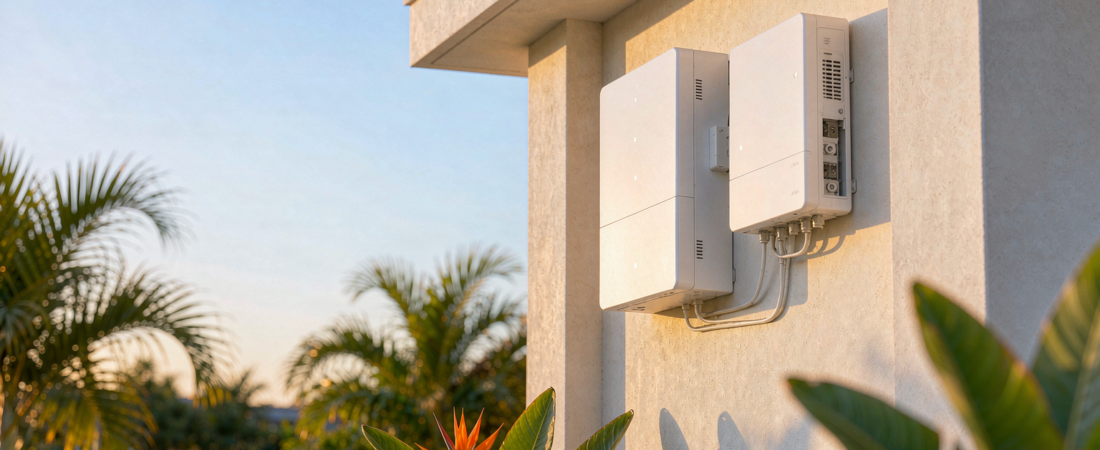
Short answer: there is no Queensland state battery rebate in 2026. What Queensland homeowners actually get is the federal Cheaper Home Batteries Program — an upfront discount of roughly $2,500 on a 10 kWh battery or $3,300–$3,600 on a 13.5 kWh battery, applied by your installer at the point of sale. That’s it. Anyone quoting a “QLD state battery rebate” is using out-of-date information.
This guide explains exactly what you can claim in Queensland right now, who qualifies, how the discount is calculated, and the one state program that still exists (for landlords, not homeowners).
Last Updated: 1 October 2026. By Leo, Solar Time Energy — solar and battery installers serving Brisbane, the Gold Coast and Ipswich.
The Federal Battery Rebate: What Queensland Homes Get in 2026
The only battery incentive available to Queensland homeowners in 2026 is the Australian Government’s Cheaper Home Batteries Program. It started on 1 July 2025 and applies in every Queensland postcode — the same terms as every other state.
It works through Small-scale Technology Certificates (STCs), the same mechanism behind the solar panel rebate. You never lodge an application or wait for a payment. Your installer calculates the discount and takes it straight off your quote.
How much you actually get:
A 10 kWh battery gets roughly $2,500–$2,700 off.
A 13.5 kWh battery (Tesla Powerwall 3 size) gets roughly $3,300–$3,600 off.
A 5 kWh battery gets roughly $1,300 off.
Important: the rebate changed on 1 May 2026. It is now tiered by battery size. The full discount applies only to the first 14 kWh of usable capacity. Capacity between 14 and 28 kWh earns 60% of the rate, and capacity between 28 and 50 kWh earns just 15%. Above 50 kWh, nothing.
What this means in practice: oversizing your battery to chase a bigger rebate no longer works. The value sweet spot is at or below 14 kWh. Right-sizing to your actual evening usage is now the smart move.
The rate is also falling. The STC factor drops again on 1 January 2027, and the program steps down every six months after that. The discount available today is the highest it will be — waiting costs you money.
Who Qualifies in Queensland?
The federal program has no income test, which is a big change from the old Queensland Battery Booster scheme. To qualify, your installation must meet these conditions:
The battery must be between 5 kWh and 100 kWh nominal capacity (STCs are paid on the first 50 kWh of usable capacity only).
It must be connected to a rooftop solar system — new or existing. A standalone battery with no solar does not qualify.
The battery must be on the Clean Energy Council approved product list.
It must be installed by an accredited installer (SAA accredited).
The system must be VPP-capable. Joining a Virtual Power Plant is optional — the hardware just has to be ready for it.
One claim per property.
How Do You Actually Claim It?
You don’t — your installer does. The process looks like this: you get an itemised quote that shows the battery model, usable capacity and the estimated STC discount; you sign; the installer installs and commissions the system; you assign the certificate rights as part of the install paperwork; the discount appears as a reduced invoice price.
The key word to look for on any quote is “usable capacity” — the rebate is calculated on usable kWh, not nominal. A “13.5 kWh” battery with 13.5 kWh usable earns the full discount; one with only 12 kWh usable earns less. Reputable installers list both numbers.
Queensland State Rebates: What Still Exists and What Doesn’t
Closed: Battery Booster. Queensland’s state battery rebate offered up to $4,000 before closing to new applications in May 2024. It has not been replaced. If a website, ad or salesperson mentions it in 2026, walk away — their information is two years out of date, and it says something about the rest of their quote.
Still live: Supercharged Solar for Renters. This is the one genuine QLD state program, and it is for landlords, not the people living in the house. Landlords can receive up to $3,500 towards rooftop solar on a tenanted property. Conditions apply: the property must rent for $1,000 per week or less, the tenant must consent, the system must be at least 3 kW, and — critically — the landlord must get conditional approval before buying or installing anything. Installing first forfeits the rebate.
Solar panel STCs: every Queensland solar installation still earns the long-running STC discount automatically — around $1,700–$1,800 off a 6.6 kW system in Brisbane in 2026, applied at point of sale. This is separate from the battery rebate and can be combined with it.
The Thing That Matters More Than Any Rebate in QLD: Feed-in Tariffs
Here is the local detail that national rebate guides skip. What your leftover solar earns has changed dramatically in Queensland, and it strengthens the case for storage.
In regional Queensland (Ergon network), the regulated feed-in tariff fell 31% to 6.006 c/kWh on 1 July 2026. In South East Queensland (Energex — Brisbane, Gold Coast, Ipswich), there is no regulated rate at all; retailers set their own, and most offers sit around 5–10 c/kWh.
Meanwhile, buying that same power back from the grid in the evening costs roughly 27–35 c/kWh.
Every kilowatt-hour you export now earns about a fifth of what it costs you to buy back. Storing your own solar for the evening beats selling it by roughly five to one — and that gap widens every time feed-in rates drop. In 2026, falling feed-in tariffs do more to justify a Queensland battery than any rebate would.
Common Traps to Avoid
Trap 1: quotes referencing the Battery Booster or a “QLD state battery rebate”. Neither exists in 2026.
Trap 2: quotes showing the pre-May-2026 rebate value. The tiered structure reduced discounts on larger batteries significantly. Check that the quote uses the current calculation.
Trap 3: quotes that don’t itemise the STC discount separately. You should be able to see the battery price, the discount and the net price as separate lines.
Trap 4: ignoring battery “usable” versus “nominal” capacity. The rebate and the real value both follow usable capacity.
Quick Answers
Is there a QLD government battery rebate in 2026?
No. The Battery Booster closed in May 2024 and was not replaced. Queensland homeowners access the federal Cheaper Home Batteries Program instead.
How much is the federal battery rebate on a 13.5 kWh battery?
Roughly $3,300–$3,600 off the installed price, depending on the current certificate price and the battery’s usable capacity. The value steps down every six months.
Can I get the battery rebate if I already have solar?
Yes. The federal program explicitly covers batteries added to existing rooftop solar. If your current inverter is not battery-ready, you may need a hybrid inverter, which adds cost — get this checked before you commit.
Do I need to join a VPP?
No. Your battery must be VPP-capable, but joining is optional. Participating can add $100–$400 a year in credits, which is worth considering.
Can renters or landlords get anything?
Landlords can apply for Supercharged Solar for Renters — up to $3,500 towards solar on a tenanted property, with conditional approval required before installation. There is no battery component to this program.
Get Your Actual Numbers
Rebate estimates are exactly that — estimates. Your real number depends on your battery’s usable capacity, the certificate price on the day, and your property. Solar Time Energy installs Sungrow and SolaX battery systems across Brisbane, the Gold Coast and Ipswich, and we itemise the federal discount on every quote so you can see exactly what you’re getting.
Call 1300 712 020 or request a free quote, and we’ll show you your actual rebate and payback based on your own usage — not a generic calculator.
Disclaimer: Information current as at 1 October 2026. Government programs, STC factors and eligibility requirements change — confirm current rules with your installer or the Clean Energy Regulator before purchasing.