Short answer: for most Queensland homes that already have solar and use real power in the evening, yes — a solar battery now pays for itself in roughly 6 to 10 years, and the federal rebate takes 30% off the upfront price. For low-usage homes on a flat tariff, it is still a close call.
The numbers that matter in QLD right now: the federal Cheaper Home Batteries Program takes about $3,300–$3,600 off a 13.5 kWh battery, Queensland has no state battery rebate (Battery Booster closed May 2024), and the regional feed-in tariff just fell 31% to 6.006 c/kWh — which quietly makes storing your own solar more valuable than selling it.
This guide gives you the actual payback maths for Brisbane and Queensland conditions — not vague “it depends” answers. We install solar and battery systems across Brisbane, the Gold Coast and Ipswich, so these are the numbers we work with every week. If you want the full picture of what every state offers, see our Australia Solar & Battery Rebates by State — 2026 Guide.
What a Battery Actually Costs in Queensland in 2026
The federal Cheaper Home Batteries Program is applied as an upfront discount by your installer — you never handle the paperwork or wait for a cheque. Since 1 May 2026 the discount is tiered by battery size:
| Usable battery capacity | STC factor | Rough discount |
|---|---|---|
| First 14 kWh | 100% | ≈ $250–270 per usable kWh |
| 14–28 kWh | 60% | ≈ $150–160 per usable kWh |
| 28–50 kWh | 15% | ≈ $38–40 per usable kWh |
| Above 50 kWh | — | No further support |
What that means for real quotes in Brisbane (installed, GST included, federal rebate applied):
| Battery size | Typical installed price (after federal rebate) | Who it suits |
|---|---|---|
| 10 kWh | $8,000–$10,000 | 2–3 person home, 5–6.6 kW solar |
| 12.8–13.5 kWh | $9,500–$13,600 | Family home, 6.6–10 kW solar (e.g. Sungrow SBR, Tesla Powerwall 3) |
| 15–16 kWh | $11,500–$14,500 | High evening usage, EV charging |
Key point from the May 2026 change: the “sweet spot” for rebate value is at or below 14 kWh. Oversizing a battery to chase a bigger rebate now backfires, because capacity above 14 kWh earns 60% and above 28 kWh only 15% of the discount. Right-sizing to your actual evening usage matters more than ever. Also note the STC factor drops again on 1 January 2027 (from 6.8 to 5.7 per kWh) and keeps stepping down every six months — the discount available today is the highest it will be.
Why QLD Feed-in Tariffs Just Changed the Battery Maths
This is the part most national guides miss, and it is the strongest argument for a battery in Queensland specifically:
- Regional QLD (Ergon network): the regulated feed-in tariff dropped from 8.660c to 6.006 c/kWh on 1 July 2026 — a 31% cut in one year. Every kWh you export is now worth about a fifth of what buying it back costs you.
- South East QLD (Energex — Brisbane, Gold Coast, Ipswich): there is no regulated rate at all. Retailers set their own, and most offers sit around 5–10 c/kWh, often with daily export caps.
- Meanwhile, buying power back costs roughly 27–35 c/kWh depending on your plan and time of use.
The gap is the whole story: a stored kilowatt-hour used at night saves you ~30c. That same kilowatt-hour exported to the grid earns you ~6c. Storing beats exporting by roughly 5 to 1 in Queensland right now — and the gap widens every time FiT rates fall.
Real Payback Numbers: Three Brisbane Households
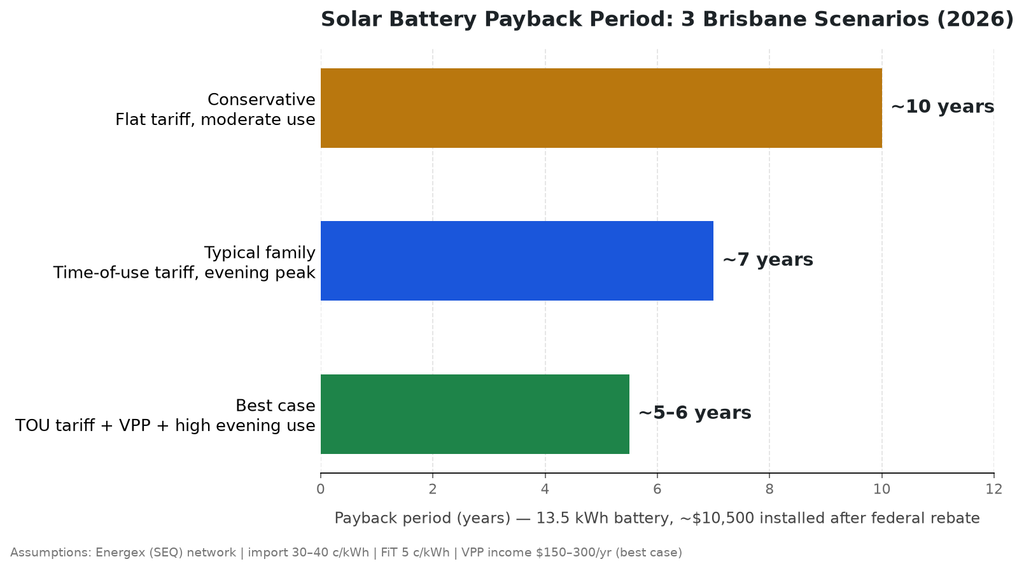
Here is the maths done honestly, with every assumption visible so you can adjust it to your own bill. All three examples assume a 13.5 kWh usable battery at ~$10,500 installed after the federal rebate, in the Energex (SEQ) network.
| Scenario | Energy shifted off the grid | Annual saving | Payback period |
|---|---|---|---|
| Conservative — flat tariff ~30c/kWh, FiT 5c, moderate evening usage | ~8 kWh/day | ~$730/yr | ~10 years |
| Typical family — time-of-use tariff, evening peak ~40c/kWh, FiT 5c | ~10 kWh/day | ~$1,280/yr | ~7 years |
| Best case — TOU tariff + VPP participation ($150–300/yr) + high evening usage | ~12 kWh/day | ~$1,700–1,900/yr | ~5–6 years |
How the saving is calculated (typical family scenario): each shifted kWh saves the ~40c evening peak rate but gives up the ~5c it would have earned as export — a net 35c. 10 kWh/day × 35c × 365 days ≈ $1,280 per year. $10,500 ÷ $1,280 ≈ 8.2 years, and real-world usage usually lands slightly better than the model because evening peak rates keep rising.
Battery warranties now run 10–15 years at 70–80% original capacity, so a 6–8 year payback leaves years of essentially free evening power after break-even. A conservative 10-year payback on a 12–15 year service life is marginal but no longer a loss — which is precisely what changed when the federal rebate arrived in July 2025 and prices fell ~25%.
The VPP bonus most QLD owners skip
Every grid-connected battery under the federal program must be VPP-capable — joining is optional, but participating programs typically pay $100–$400 a year in credits or bonus feed-in rates for letting the operator dispatch your battery during grid peaks. On a 7-year payback, VPP income can pull 6–12 months off it. Check the dispatch terms before signing: good programs limit how often and when your battery is used, and let you set a reserve charge level.
When a Battery IS Worth It in QLD
- You already have solar and export a meaningful amount during the day (check your inverter app or bill)
- Your household uses real power between 5pm and 11pm — air con, cooking, pool pump on timer issues, teenagers
- You are on a time-of-use tariff with a decent peak/off-peak spread
- You want blackout protection (note: backup during outages requires specific hardware and wiring — it is not automatic with every install, so discuss it at design stage, not after)
- You are planning an EV — charging overnight from your own stored solar is the cheapest kilometres you will ever buy
- You are considering it in 2026 rather than later — the rebate steps down every six months, so waiting costs money
When It Is NOT Worth It (Yet)
- No solar: a battery alone cannot claim the federal discount — it must be paired with rooftop solar (new or existing)
- Low usage: a couple using 8–10 kWh/day with most consumption in daylight hours may never shift enough energy to justify $9,000+
- Flat tariff + small system: if your 5 kW system barely covers daytime use, there is little surplus left to store — add panels or size up the system first
- Moving within ~4 years: batteries do add appeal and value to a listing, but you are unlikely to recoup the outlay that fast through savings alone
- Your existing inverter is not battery-ready: retrofitting may require a hybrid inverter ($1,500–$3,000 extra) — get this checked before you price a battery
QLD Rebates: What You Can and Cannot Claim in 2026
| Program | Value | Status in 2026 |
|---|---|---|
| Federal Cheaper Home Batteries Program | ~30% off installed battery, tiered by size | Live — applied at point of sale, no income test, one claim per property |
| QLD Battery Booster | Up to $4,000 | Closed May 2024 — any installer quoting it is using old material |
| Supercharged Solar for Renters | Up to $3,500 | Live — landlords only, for solar on tenanted properties (opened 12 Dec 2025) |
| Solar STCs | ~$1,700–1,800 off a 6.6 kW system | Live — automatic with any solar install |
Beware any Queensland quote that mentions a “state battery rebate” — it does not exist in 2026. The federal discount is the only battery incentive, and it applies identically in every QLD postcode.
The Verdict for Queensland Homes
For a typical Brisbane family home with existing solar and evening-heavy usage: yes, a battery is worth it in 2026. A realistic 6–8 year payback, a 10–15 year asset life, federal rebate support that shrinks every six months, and feed-in tariffs that keep collapsing all point the same direction.
If you use little power at night, hold off — improve your tariff, check your usage patterns first, and revisit when your circumstances change. A battery is a right-sizing decision, not a fashion purchase.
The single most useful thing you can do before deciding: look at your last 12 months of bills and note (1) your daily usage in kWh, (2) how much solar you exported, and (3) whether you are on a flat or time-of-use tariff. Those three numbers determine your payback almost entirely.
Get Your Real Numbers — Not an Estimate
Solar Time Energy installs Sungrow and SolaX battery systems across Brisbane, the Gold Coast and Ipswich. Send us your recent bill and we will show you your actual payback period based on your usage — no obligation, no generic quote.
Call 1300 712 020 or request a free assessment on our solar battery service page.
Frequently Asked Questions
How long does a solar battery last in Queensland heat?
Most quality lithium (LFP) batteries carry 10–15 year warranties guaranteeing 70–80% capacity retention. Queensland heat is a factor — batteries should be installed in shaded, ventilated locations, ideally out of direct western sun. A garage or south-facing wall is ideal in Brisbane.
Can I add a battery to my existing solar system?
Usually yes. The key question is whether your current inverter is battery-ready (hybrid) or needs replacing. Sungrow and SolaX hybrid inverters make later battery add-on straightforward — which is why we recommend planning for storage at the initial solar install even if you buy the battery later.
Is the federal battery rebate going away?
The program is funded to 2030, but the discount steps down every six months and was restructured on 1 May 2026 to favour smaller systems. The value available today is the highest it will be going forward.
Does a battery power my home during a blackout?
Only if the system is configured for backup. A standard grid-connected install shuts down during an outage for safety. Backup capability requires specific hardware and switchboard wiring — confirm it explicitly in your quote if blackout protection matters to you.
What size battery does a typical Brisbane home need?
Most homes are best served by 10–14 kWh. Check your evening usage (roughly 4pm–11pm): a battery should cover that consumption with a small buffer, not your full daily usage. Oversizing wastes money, especially now the rebate tapers above 14 kWh.
Written by Leo — Solar Time Energy, Brisbane. Leo leads the team at Solar Time Energy, a local solar and battery installer servicing Brisbane, the Gold Coast and Ipswich. The company installs LONGi panels with SolaX and Sungrow inverters and batteries, and is a proud sponsor of the Runcorn Rockets Basketball Club.
Disclaimer: Figures current as at 30 September 2026 and based on typical Brisbane/Energex conditions. Rebate values, tariffs and eligibility vary by property and change over time — confirm current rules and your personal numbers before purchasing.