Solar Panels on Tile, Tin & Colorbond Roofs: The Complete Gold Coast Guide (With System Size Matching)
By Leo · Solar Time Energy · Serving Gold Coast, Brisbane & Ipswich · Updated September 2026
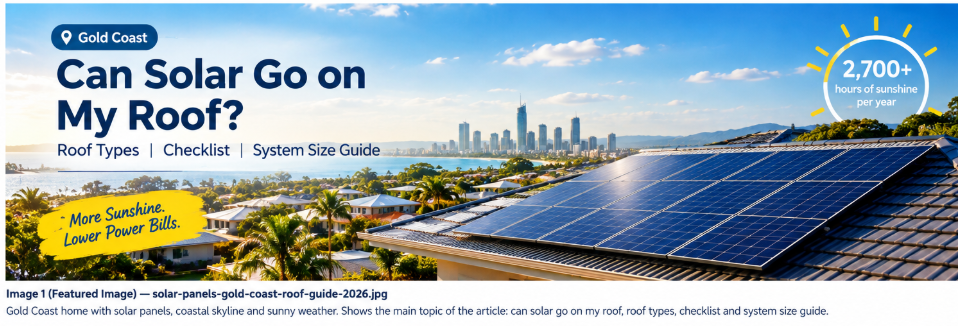
Gold Coast homes are blessed with some of the best solar conditions in Australia — over 2,700 hours of sunshine a year and a subtropical climate that keeps panels producing all four seasons. But before you get to the exciting part (lower power bills), there’s a question almost every homeowner asks first:
“Can solar even go on my roof?”
The answer depends on three things: what your roof is made of, how much usable roof space you have, and how much electricity your household actually uses. This guide walks through all three — with a practical checklist you can use before you even call an installer, and a system-size matching table so you know whether a 6.6kW, 10.56kW or bigger system fits your home.
What Kind of Roofs Do Gold Coast Homes Have?
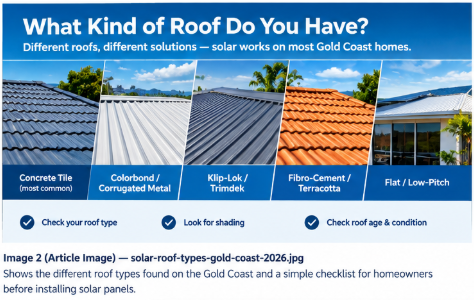
The Gold Coast’s housing stock is a mix of eras and styles, and each comes with a different roof story:
- Concrete tile roofs — the most common roof in established suburbs like Robina, Mermaid Waters, Coomera and Pacific Pines. Most project homes built from the 1990s onwards use concrete tiles. Good news: they take solar well with the right mounting hardware.
- Colorbond / corrugated metal roofs — increasingly popular on newer builds in Pimpama, Ormeau and the northern growth corridor, and standard on sheds, patios and carports. The easiest roof type to install on.
- Klip-Lok / Trimdek profiles — common on architecturally designed homes, canal-front properties and modern renovations, especially in areas like Broadbeach Waters, Sorrento and Paradise Waters.
- Older fibro-cement and terracotta roofs — found in post-war homes around Southport, Miami, Palm Beach and through the hinterland (Currumbin Valley, Mudgeeraba). These need an extra look before panels go up — see the asbestos warning below.
- Flat or low-pitch roofs — canal homes and contemporary builds often have low-pitch sections. Solar works fine here; the design just needs thought.
Checklist 1: Identify Your Roof Type (Before You Call Anyone)
Take two minutes and answer these:
- Look at your roof from the ground — is it stepped and ridged (tiles) or smooth, flat sheets (metal)?
- If it’s tiles: are they grey concrete or orange-brown terracotta? Concrete is easier; terracotta is brittle and needs a careful installer.
- If it’s metal: can you see raised ribs running down the sheet (Klip-Lok) or gentle waves (corrugated/Trimdek)?
- How old is the roof? Under 15 years = usually no issue. 15–25 years = worth an inspection. 25+ years or showing cracked/missing tiles = consider repairs first.
- Any visible damage: cracked tiles, rust spots on metal sheets, sagging lines, or water stains on your ceiling?
- Is your home pre-1985 with a grey, cement-sheet roof? Stop — check for asbestos first.
- Any shading from trees, neighbouring two-storey homes or chimneys at midday?
Got your answers? Now let’s go through each roof type.
Solar on Concrete Tile Roofs
Concrete tiles are the workhorse of Gold Coast suburbia, and solar installers handle them every week of the year. The method: the installer lifts the relevant tiles, fixes a tile hook to the timber rafter underneath, then sets the tile back down neatly over the hook. Rails run across the hooks, and the panels mount to the rails.
Done properly, the roof stays fully watertight and the panels sit flush — most people can’t spot the system from the street.
What to watch for
- Walking damage. Tiles can crack under foot during installation. A professional crew brings spare tiles and replaces any that break — ask whether spares are included in the quote.
- Old, brittle tiles. If your roof is 20+ years old, a pre-install inspection is worth it. If tiles are failing, it’s far cheaper to restore the roof before solar than to remove and refit the system later.
- Sealing quality. Every penetration point must be flashed and sealed properly. This is where cheap installs cut corners — and where leaks show up two years later.
Verdict: Concrete tile is a great solar roof. Just make sure your installer has substantial tile experience.
Solar on Colorbond / Corrugated Metal Roofs
If you have a metal roof, you’ve won a small lottery. Corrugated and Trimdek sheets are fixed with tin feet screwed and sealed at the crest of the corrugation — a well-proven method, and the install is typically faster and tidier than tile.
Metal roofs also run in long, unbroken planes, which means efficient panel layouts and often more usable space than a roof chopped up by tiles and ridges.
What to watch for
- Fix into the structure, not the air. Screws must land on purlins or battens — not in the middle of unsupported sheet. This is basic, but it separates careful installers from rushed ones.
- Coastal corrosion. Within a few kilometres of the water, salt air is the enemy. Quality installers use corrosion-resistant fasteners rated for coastal exposure — ask specifically.
- Older, thinned sheeting. Rust-pitted sheets on older sheds and patios may need replacing before they take a panel load.
Verdict: For many Gold Coast homes, a Colorbond roof is close to the ideal solar surface.
Solar on Klip-Lok and Standing-Seam Roofs
Klip-Lok’s raised ribs allow special clamps that grip the seam directly — in most cases with zero penetration of the roof sheet at all. No holes means no leak risk, and the mounting is among the cleanest available. It’s the preferred roof of plenty of solar installers for exactly this reason.
The only consideration: the clamps must match the specific profile. A satellite-quote-only installer can get this wrong; a company that visits your roof won’t.
Verdict: Best-in-class for solar. Often the simplest, longest-lasting mounting method available.
Flat and Low-Pitch Roofs (Canal Homes & Modern Builds)
Panels laid flush on a low-pitch roof still perform well on the Gold Coast’s strong sun. The two things to know:
- Cleaning. Panels that sit close to flat don’t shed dust and grime as easily as steep ones — rain doesn’t wash them clean. Keep an eye on your monitoring app; if output drifts down, a panel clean fixes it.
- Tilt frames. They can lift panels to a steeper angle, but they add cost, wind loading and shading gaps between rows, which means fewer panels fit. On most homes, a flush layout at the roof’s own pitch uses the available space better.
⚠️ Asbestos warning for pre-1985 homes: Grey fibro-cement roofing was common on Australian homes built between the 1950s and mid-1980s, including parts of the Gold Coast and hinterland. Disturbing asbestos during a solar install releases dangerous fibres, and most reputable installers will decline to drill into it. If your roof is asbestos, the right path is: licensed asbestos removal → re-roof → then install solar. It’s an added cost, but you end up with a new roof and a new system designed together. We can walk you through the sequence — just ask.
Checklist 2: Match a System Size to Your Home
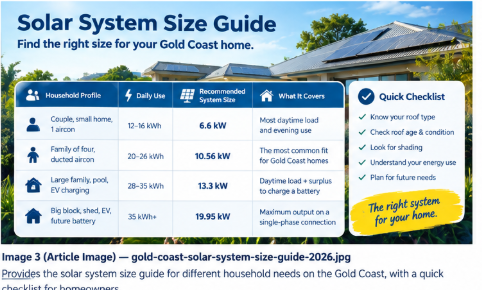
Roof type decides how solar goes on. Roof space and household usage decide what size. Here’s how Gold Coast homes typically map across our range — from an entry-level 6.6kW through to large 19.8kW systems:
| System Size | Typical Household | Roof Space Needed (approx.) | Best Fit For |
|---|---|---|---|
| 6.6kW | 1–3 people, single-storey | ~30 m² (14–16 panels) | The Gold Coast classic. Suits most 3–4 bedroom homes in Robina, Coomera or Mermaid Waters with average daytime usage. The most popular system in Australia for a reason. |
| 10.56kW | 3–5 people, or battery-ready homes | ~48 m² (22–24 panels) | Families running pool pumps and air conditioning through the day, or homes planning a SolaX / Sungrow battery. Big step up in coverage without needing a huge roof. |
| 13.2kW | 4–6 people, high daytime usage | ~60 m² (28–30 panels) | Large single-storey homes, homes with ducted air con, EV charging at home, or double-storey houses with generous north-facing roof planes. |
| 19.8kW | High-consumption properties | ~90 m² (42+ panels) | Canal-front and acreage properties (Mudgeeraba, Bonogin, Currumbin Valley), homes with pools + EVs + ducted systems, or small home-business setups. Also popular where future battery capacity is planned. |
Roof space figures assume standard ~440W panels on a reasonably unobstructed roof. Tile roofs with many ridges and valleys effectively “lose” some usable area compared to metal — another reason the on-site assessment matters.
Two rules that matter more than the table
- Size to your daytime usage, not your bill total. Solar pays you back through the power you use while the sun is up (and the power a battery stores for the evening). A household that’s home all day gets more from a bigger system than a household that’s empty from 8 to 5.
- Bigger systems are cheap per kilowatt. The fixed costs (design, install labour, inverter) are largely the same whether you install 6.6kW or 13.2kW — so the marginal cost of extra panels is low. If your roof allows it and a battery or EV is anywhere in your future, it’s usually worth oversizing now.
Orientation & Pitch on the Gold Coast — Quick Reference
- North-facing roof planes are the gold standard in Australia — maximum output across the whole day.
- East-facing sections produce early (great for morning usage); west-facing produce late afternoon (great for air con and battery charging). An east+west split often works brilliantly for families.
- The Gold Coast’s latitude (~28°S) suits roof pitches of roughly 20–30°, which happens to match most residential roof pitches — so a flush-mounted system performs near-optimally without tilt frames.
- South-facing planes are the last resort — usable in some cases, but expect noticeably reduced output.
Checklist 3: Your Pre-Install Assessment — What a Good Installer Checks
On the day of assessment, expect all of this — and be wary of anyone who skips it:
- Roof type, profile and condition (close-up inspection, not just satellite imagery)
- Rafter/batten spacing and condition — especially on homes 20+ years old
- Any cracked tiles, rust, or previous leak points
- Switchboard capacity and location (older Gold Coast homes often need a switchboard upgrade)
- Shading analysis across the day and seasons
- Inverter and (if planned) battery placement — shaded, ventilated spots out of the western sun
- A system design matched to your actual usage — based on your recent bills, not a guess
Frequently Asked Questions
Can solar be installed on any roof?
Almost any structurally sound roof — tile, corrugated metal, Klip-Lok, Trimdek and most others. The exceptions are asbestos roofs (remove first) and roofs with structural damage that needs repair.
Will solar damage my tile roof or cause leaks?
Not when it’s done properly. Tile systems use hooks fixed to the rafters with the tiles reseated over them — no tiles are broken in the finished roof, and penetrations are flashed and sealed. Leaks almost always trace back to rushed workmanship, which is why workmanship warranty matters as much as panel warranty.
Is 6.6kW enough for a Gold Coast home?
For many households, yes — a 6.6kW system produces well in our climate and covers typical daytime usage for a family of 2–4. But if you run air conditioning all day, have a pool, or plan a battery or EV, ask about 10.56kW or 13.2kW — the extra panels cost relatively little on top of a standard install.
Do I need to fix my roof before installing solar?
If tiles are cracked, ridge caps are failing or metal sheets are rusting — yes. Doing roof work under an operating solar system means removing and refitting panels, which costs far more than fixing the roof first.
How long does an install take?
Most residential systems (6.6kW–13.2kW) are completed in a single day on metal roofs, and a day to a day-and-a-half on tile roofs.
Not Sure What’s on Your Roof? That’s Our Job.
Every Solar Time Energy quote starts with a proper on-roof assessment — roof type, condition, structure and shading — and a system design matched to your actual electricity usage. No satellite-image guesswork, no one-size-fits-all package.
Call us for a free Gold Coast roof assessment: 1300 712 020
Serving Gold Coast, Brisbane & Ipswich · JinkoSolar, LONGi & Seraphim panels · SolaX & Sungrow batteries