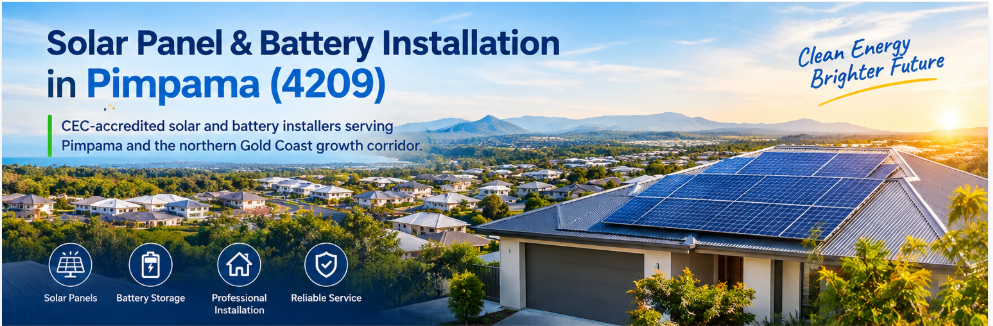
CEC-accredited solar and battery installers serving Pimpama and the northern Gold Coast growth corridor. Written by Solar Time Energy — updated September 2026.
Pimpama has gone from cane fields to one of the fastest-growing suburbs in Australia in barely fifteen years. At the 2021 Census it had 24,601 residents and a median age of just 29, and around 80% of its dwellings are detached houses sitting inside master-planned estates. That combination — big roofs, young families, high daytime and evening power use — makes Pimpama one of the strongest suburbs on the Gold Coast for rooftop solar and battery storage.
Solar Time Energy designs, supplies and installs solar panel and battery systems throughout Pimpama and the surrounding corridor, including Gainsborough Greens, Pacific Cove, Pimpama Village, and the neighbouring suburbs of Coomera, Upper Coomera, Willow Vale and Ormeau Hills.
Why Pimpama homes are well suited to solar
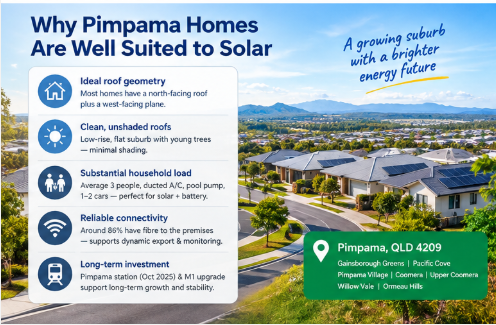
A handful of local factors make Pimpama unusually straightforward for a well-designed system:
Roof geometry. The street grids in the newer estates largely run east–west, so most homes have one large north-facing roof plane plus a usable west-facing plane. North carries the bulk of generation; west is worth including because it produces during the 4–8pm window when grid power is at its most expensive.
Clean, unshaded roofs. Pimpama is a low-rise, flat suburb with young street trees. Most roofs we inspect have little or no shading, so panels perform close to their rated output.
Substantial household load. Households average three people with a median weekly household income of $1,863 (ABS 2021). Ducted air conditioning, a pool pump and one or two cars is the common profile — and that load profile is exactly what solar plus a battery is built to serve.
Reliable connectivity. Around 86% of Pimpama premises have fibre to the premises, which matters more than most people realise: a dynamic export connection and remote battery monitoring both depend on a stable internet link.
A consolidating, not speculative, suburb. Pimpama railway station opened in October 2025 as part of the Cross River Rail programme, and the M1 Exit 49 interchange upgrade is well advanced. Infrastructure of that scale supports long-term ownership — which is what makes a 15–25 year solar asset make sense.
Roof type note. Newer Pimpama estates are predominantly Colorbond steel or concrete tile. Both are straightforward to mount on, but they use different hardware and different flashing approaches — steel roofs get clamped or screw-fixed with EPDM-sealed fasteners, tile roofs get tile brackets and replacement tiles at each penetration. A quote that doesn’t ask about your roof type isn’t a real quote.
Rebates available on a Pimpama installation in 2026
Queensland currently has no active state-level battery rebate — the Queensland Battery Booster closed to new applications in May 2024. That means your support comes from the two federal schemes below, both administered by the Clean Energy Regulator and both applied as a discount off the upfront price rather than a cashback you chase later.
- Federal STC rebate (solar panels)
Installing solar generates Small-scale Technology Certificates (STCs). Your installer assigns the right to create those certificates to a registered agent and passes the value straight through as a discount. The number of STCs depends on system size, your postcode zone (Gold Coast is Zone 3, rating 1.382) and the deeming period — the years of future generation you can claim upfront.
The deeming period dropped from 6 years to 5 years on 1 January 2026, and it falls by one year every January until the scheme ends in 2030. In practical terms, waiting a year costs you roughly $130–$180 on a 6.6 kW system.
System size Approx. STCs (Zone 3) Approx. upfront discount
6.6 kW ~46 ~$1,800
10.56 kW ~73 ~$2,850
13.2 kW ~91 ~$3,550
Indicative only, calculated at an STC market price of roughly $39 (September 2026). The STC price moves with the market, so we apply the exact figure on the day you sign.
- Cheaper Home Batteries — the federal battery rebate
This programme launched on 1 July 2025 and, on 1 May 2026, changed from a flat rate to a tiered one: the first 14 kWh of usable capacity attracts the full rate, with progressively smaller support above that. The rebate covers roughly 30% of a typical battery’s installed cost.
Usable battery capacity Rebate rate (May–Dec 2026)
First 14 kWh Full rate — approx. $252–$272 per kWh
14–28 kWh 60% of the full rate — approx. $151–$162 per kWh
28–50 kWh 15% of the full rate — approx. $38–$40 per kWh
Above 50 kWh No further rebate
In dollar terms, that works out to roughly:
10 kWh battery — about $2,500–$2,700 off
13.5 kWh battery (e.g. a Powerwall 3) — about $3,400–$3,650 off
21 kWh battery — about $4,600–$4,900 off
Eligibility conditions matter here. The battery must be on the Clean Energy Council’s approved product list, be Virtual Power Plant (VPP) capable, be connected to new or existing rooftop solar, and be installed by a CEC-accredited installer. The rebate is not means-tested. It applies to homes, small businesses and community organisations, and a given address can only claim once for a first install, an expansion, or a replacement.
Timing is genuinely worth thinking about. The battery rate steps down again on 1 January 2027 — expected to land around $210–$215 per kWh on the first band — and the programme ends on 31 December 2030. The STC deeming period drops another year in January 2027 as well. The rebate you can claim today is the largest it will ever be.
What about feed-in tariffs in Pimpama?
Feed-in tariffs in South East Queensland are set by your electricity retailer, not the government, and typically land somewhere in the 5–10 cents per kWh range. Compare that with what you pay to buy power from the grid — often three to four times that. The conclusion is straightforward: every kilowatt-hour you use in your own home is worth several times more than one you export. That’s the core argument for right-sizing your system around your own consumption rather than maximising panel count, and for adding a battery if you have a meaningful evening load.
Energex connection rules for Pimpama (4209)
Pimpama sits on the Energex network, and any grid-connected solar or battery system needs a network connection application before installation. The limits that actually shape your design are:
Connection type Inverter limit Export limit
Single phase — dynamic 10 kW solar + 10 kW battery inverter Up to 10 kW variable
Single phase — fixed 10 kW combined solar and battery 5 kW
Three phase — dynamic 30 kW combined Up to 10 kW per phase
Three phase — fixed 30 kW combined 5 kW per phase
SWER line 10 kW combined 2 kW
Why we push for a dynamic connection on single-phase homes. Under the standard fixed arrangement, a single-phase Pimpama home gets 10 kW of inverter capacity but can only push 5 kW back to the grid. On a clear day your inverter simply throttles — and that curtailed energy earns you nothing. A dynamic connection lets the export limit rise to 10 kW whenever the local network has headroom, which on a Pimpama feeder with plenty of new infrastructure is most of the time. There is no extra hardware to buy for it; it’s an application choice, and it’s the single most valuable thing an installer can get wrong.
On timing: applications for systems under 5 kW are usually approved within an hour, but anything above 5 kW can take up to five weeks. We lodge and manage the application for you — but if you have a deadline, factor that in.
What size system suits a Pimpama home?
System sizing should follow your consumption, not the other way round. As a starting guide for Pimpama’s housing stock:
Home profile Recommended solar Battery
Townhouse or small single-storey, low daytime use, two occupants 6.6 kW Optional — 10 kWh if evening load is high
Standard 4-bed single-storey with ducted air conditioning 10.56 kW 10–13.5 kWh
Double-storey family home with pool pump and EV charging 13.2 kW 13.5–21 kWh
Home with high winter evening use or frequent grid outages 10.56–13.2 kW 21 kWh+ with backup circuits wired
One local observation worth acting on: a large share of Pimpama’s housing was built with a builder-supplied solar package, and those packages are frequently sized to meet the minimum specification rather than the household’s actual load. If your home was handed over with a small array and a basic string inverter, an honest review of your bills will usually show that adding capacity or adding storage returns more than starting over — and if your inverter is battery-ready, you can often keep it.
A worked example: a four-bedroom Pimpama home
A typical Pimpama case — four bedrooms, single storey, ducted reverse-cycle air conditioning, a pool, both adults working, two teenagers, bills running high through summer.
We would propose 10.56 kW of panels on the north and west roof planes plus a 13.5 kWh battery. The array covers the daytime ducted load and charges the battery; the battery then carries the house through the evening peak instead of buying power at the top tariff. Surplus that would otherwise be exported at a few cents is stored and used later at full retail value.
On the financial side, that configuration attracts roughly $2,850 in STC discount on the solar plus roughly $3,500 on the battery under the current federal rate — around $6,350 passed straight off the upfront price. The exact figures depend on your roof, your switchboard, your single or three-phase supply, and the certificate price on the day. We confirm the precise numbers on your written quote rather than quoting a number we can’t hold.
Pimpama-specific installation considerations
Storm and hail
South East Queensland’s storm season regularly brings hail through the northern corridor, and the Gold Coast has had damaging hail events in recent years. Mounting quality and cable management are what separate a system that rides out a storm from one that ends up as an insurance claim. We use cyclone-rated mounting systems, keep cable runs in UV-stabilised conduit, and specify panels with documented hail ratings — then hand you the test certificates.
Flood and overland flow
Parts of Pimpama sit near the Pimpama River and local creek systems. Where a property is in a flood-affected pocket, we set inverters and batteries above the relevant flood level rather than at garage floor height. A flooded battery isn’t just dead — it’s a safety event. This is a design decision made at quote stage, not something you can fix afterwards.
Estate design covenants
Several Pimpama estates have design guidelines covering visible roof alterations. It is worth checking your covenant before the install day. In the great majority of cases panels are permitted, but knowing before rather than after avoids a stalled job.
Salt and humidity
Pimpama is a few kilometres inland, so it doesn’t carry the same corrosion load as beachfront suburbs like Main Beach or Palm Beach. Standard marine-grade mounting hardware is still the right call given the humidity, but there’s no need to pay a coastal premium here.
How the process works
Bill review and sizing. Send us a recent bill and we’ll work out your daytime and evening consumption split, then size the system around it. No cost, no obligation.
Written quote with rebates applied upfront. STC and battery rebate values shown as line items, not buried in a lump sum.
Energex network application. We lodge it, we chase it. Allow up to five weeks for anything above 5 kW.
Installation day. Most residential systems are completed in a single day. Your power is only off during the switchboard changeover.
Paperwork and handover. We lodge the required Energex EWR form within five days of installation, arrange the meter change, and walk you through the monitoring app before we leave.
Frequently asked questions
How much does solar cost in Pimpama in 2026?
After the federal STC discount, a quality 6.6 kW system typically lands in the mid four-figures installed, and a 10.56 kW system in the low-to-mid five figures before any battery. Battery pricing varies widely by brand and capacity, and the federal rebate currently covers around 30% of the installed cost. Because STC prices and battery hardware pricing both move, we quote a firm figure rather than publish a number that will be wrong next month.
Do I need Energex approval to install solar in Pimpama?
Yes. Any system connected to the grid needs a network connection application approved by Energex before installation. Systems under 5 kW are usually approved within an hour; larger systems can take up to five weeks. We handle the application as part of every job.
Is a battery worth it in Pimpama?
It depends on your evening load. With feed-in tariffs in the 5–10 cent range and grid power costing several times that, every kilowatt-hour you shift from export to self-consumption is worth more than the one you sell. If your household uses meaningful power between 4pm and 9pm — and most Pimpama family homes with ducted air conditioning and a pool do — a battery typically pays back well inside its warranty period. The federal rebate is also at its highest point right now and falls from January 2027.
Will my solar keep working during a blackout?
Not by default. A standard grid-tied system shuts down automatically during an outage — this is a mandatory safety feature that protects network workers. To have power during an outage you need a battery with backup circuits deliberately wired at installation, which is a design decision made at quote stage, not an add-on afterwards.
How long does installation take?
Most single-phase residential systems in Pimpama are installed in one day. The only interruption to your power is the switchboard changeover. Larger three-phase systems or combined solar-plus-battery jobs can run to two days.
What size system for a four-bedroom Pimpama home?
For a four-bedroom single-storey home with ducted air conditioning, 10.56 kW is the most common choice, usually paired with a 10–13.5 kWh battery. Double-storey homes with a pool and EV charging are better served by 13.2 kW. During the quote we model this against your actual bill rather than applying a rule of thumb.
Get a free solar and battery quote for your Pimpama home
We’ll review your bill, model the system against your real consumption, and show your STC and battery rebate as separate line items — no obligation.
1300 712 020
Solar Time Energy · www.solartimeenergy.com.au
Also installing across the northern Gold Coast:
Solar installers across the Gold Coast
North Gold Coast — Coomera, Pimpama & Helensvale
Solar installation in Coomera
Solar installation in Upper Coomera
Solar installation in Ormeau & Ormeau Hills
Sources and currency of information
Population, median age, household income and dwelling type: ABS 2021 Census (Pimpama, QLD 4209).
Rebate rates, tiers, deeming period and eligibility: Clean Energy Regulator and the Department of Climate Change, Energy, the Environment and Water, as at September 2026.
Network inverter and export limits: Energex published connection rules, updated August 2026.
Queensland Battery Booster closure: Queensland Government.
Rail and road infrastructure: Queensland Government (Cross River Rail — Pimpama station, opened 20 October 2025) and Queensland Department of Transport and Main Roads (M1 Exit 49 upgrade).
Internet technology mix: NBN Co premises data.
Rebate amounts, tier thresholds and certificate prices are set by government and market conditions and change over time. Figures on this page reflect the position in September 2026 and are indicative; the exact rebate applicable to your installation is confirmed on your written quote.
About Solar Time Energy
Solar Time Energy is a Brisbane-based solar and battery installer, and we work right across the northern Gold Coast — Pimpama, Coomera, Upper Coomera and Helensvale included.
We keep our product range deliberately narrow. That means LONGi Tier 1 solar panels, paired with SolaX or Sungrow inverters and batteries. We’re certified installation experts for both brands, so we know how their systems behave on a Gold Coast roof — and we design them so you can add storage later without replacing your inverter.
Every system we quote is battery-ready from day one. Pricing is transparent and upfront, the workmanship warranty runs for 10 years, and 12 months interest-free finance is available with $0 upfront. We also install EV charging for homes and businesses.
We’re a local business that gives back too — proud sponsors of the Runcorn Rockets Basketball Club.
Call 1300 712 020 or visit www.solartimeenergy.com.au for a free assessment.