A typical 10kWh home battery in Brisbane costs around $9,000 – $12,000 installed before the federal rebate, or roughly $6,100 – $8,400 after the Cheaper Home Batteries Program discount is applied upfront (May–December 2026 rates). Installed costs generally work out to $1,000 – $1,300 per kWh for quality brands like Sungrow and SolaX.
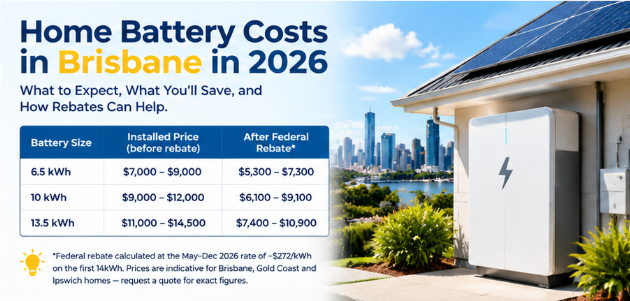
| Battery Size | Installed Price (before rebate) | After Federal Rebate* |
|---|---|---|
| 6.5 kWh | $7,000 – $9,000 | $5,300 – $7,300 |
| 10 kWh | $9,000 – $12,000 | $6,100 – $9,100 |
| 13.5 kWh | $11,000 – $14,500 | $7,400 – $10,900 |
*Federal rebate calculated at the May–Dec 2026 rate of ~$272/kWh on the first 14kWh. Prices are indicative for Brisbane, Gold Coast and Ipswich homes — request a quote for exact figures.
What’s Included in the Installed Price?
A properly quoted battery price should always include:
- The battery module itself — the biggest cost component
- A hybrid inverter (if your existing solar inverter isn’t battery-ready)
- Installation and switchboard work — including any meter upgrades
- Federal rebate paperwork — we apply the ~30% discount upfront, so you never pay the full amount and wait for a refund
- Warranty registration and monitoring setup
If a quote only lists “battery + install” without these line items, ask what’s excluded — that’s where surprise costs hide.
6 Factors That Change Your Battery Price
- Brand tier: Sungrow SBR series typically sits at $8,000–$12,000 installed; SolaX systems run $7,500–$11,000. Premium European brands can cost 30–50% more.
- Battery-ready vs full hybrid: if you already have a hybrid inverter, you save $1,500–$3,000.
- Backup requirement: whole-home backup circuits add $500–$1,500 compared to backup for essential loads only.
- System size: bigger batteries cost more in total but less per kWh.
- Switchboard condition: older homes in Ipswich and inner Brisbane sometimes need switchboard upgrades ($400–$1,200).
- Timing: the federal rebate steps down every six months — the rate is $272/kWh now, dropping to ~$228/kWh from January 2027. Installing sooner locks in the higher discount.
Sungrow vs SolaX: Which Offers Better Value in 2026?
| Model | Usable Capacity | Installed Price* | Warranty |
|---|---|---|---|
| Sungrow SBR096 (9.6 kWh) | 9.6 kWh | $9,500 – $12,000 | 10 years |
| SolaX Triple Power T-BAT (10.1 kWh) | 10.1 kWh | $8,500 – $11,000 | 10 years |
*Before federal rebate. Both brands are VPP-capable and on the Clean Energy Council approved list — required for the federal rebate.
Our take for Brisbane homes: both are excellent. SolaX usually wins on upfront price; Sungrow edges ahead on cycle life and its track record with Queensland heat. We install both — the right choice depends on your existing inverter and backup needs.
How the Federal Battery Rebate Reduces Your Cost
Since 1 July 2025, the federal Cheaper Home Batteries Program has cut roughly 30% off installed battery prices. Key 2026 facts every Brisbane homeowner should know:
- The discount is applied upfront by your installer through the STC scheme — no claiming back later
- From 1 May 2026, the rebate pays about $272 per kWh on the first 14 kWh of usable capacity
- Capacity above 14 kWh receives a reduced rate (60% tier up to 28 kWh, 15% tier up to 50 kWh)
- The battery must be VPP-capable (joining a VPP remains voluntary) and installed by an accredited installer
- One rebate per electricity meter — no income test applies
- The per-kWh rate falls every six months: ~$228/kWh from January 2027, ~$208/kWh from July 2027
Example: a 10kWh Sungrow battery installed in Brisbane in late 2026 receives roughly $2,720 – $2,900 in federal discount, applied directly on your invoice.
Payback: How Long Until the Battery Pays for Itself?
For most South East Queensland households, realistic payback periods are:
- With federal rebate + solar self-consumption: 6–9 years
- With rebate + VPP participation: 5–8 years (VPP payments typically add $300–$500/year)
- Without any rebate: 9–12 years — this is why the rebate matters
Homes with evening air-conditioning usage, a pool pump, or an EV see the fastest payback because they use more of their stored solar instead of buying peak-rate power.
Frequently Asked Questions
Is $10,000 too much for a home battery?
For a quality 10kWh system from a brand like Sungrow or SolaX, $9,000–$12,000 installed is the normal Brisbane market range in 2026. Significantly cheaper quotes usually mean off-brand cells, excluded inverter costs, or the rebate not being passed through.
Do I need solar panels to get the battery rebate?
Yes — the federal rebate requires the battery to be installed with a new or existing rooftop solar system. If your home doesn’t have solar yet, a solar + battery package usually costs less than you’d expect after the solar STC discount and battery rebate stack.
Should I wait for battery prices to fall further?
Battery hardware is getting cheaper, but the rebate is falling faster — roughly $44/kWh less from January 2027. Waiting six months typically costs you more in lost rebate than you’d gain in hardware price drops.
What size battery do most Brisbane families install?
10–13.5 kWh is the sweet spot for a family using 20–30 kWh/day. It covers evening consumption without paying for capacity you’ll never cycle.
Written by Leo, Solar Time Energy — serving Brisbane, Gold Coast and Ipswich with solar, battery and EV charging solutions. Last updated: September 2026. Get a fixed-price battery quote →